

Gold Retreats from Record High as Risk Appetite Returns Gold prices pulled back sharply on Friday, falling nearly 2% from a record high of $4,379 to trade around the $4,230–$4,240 zone. The decline followed comments from U.S. President Donald Trump suggesting that triple-digit tariffs on Chinese imports were “unsustainable,” easing fears of an escalating trade conflict. The shift in tone revived risk appetite across global markets, lifting the U.S. Dollar and Treasury yields — both of which typically weigh on non-yielding assets like gold. The 10-year U.S. Treasury yield rose by three basis points to 4.01%, further pressuring bullion prices. Federal Reserve officials also reaffirmed their commitment to bringing inflation back to the 2% target, signaling that monetary policy may stay restrictive despite growing market expectations for rate cuts later this year. Investors are now turning their attention to next week’s Consumer Price Index (CPI) report, which could offer fresh clues on the Fed’s next policy move. Despite the recent pullback, gold remains one of 2025’s strongest-performing assets, gaining more than 60% year-to-date amid persistent geopolitical tensions, robust central bank demand, and a global shift toward de-dollarization. Analysts at Standard Chartered and HSBC expect the metal’s bullish trend to continue into 2026, with average price targets between $4,400 and $5,000 per ounce. Technical Outlook: Gold’s broader uptrend remains intact despite the short-term correction. Key support levels are seen at $4,200 and $4,185, while resistance lies at $4,300, $4,350, and the all-time high of $4,389. A sustained close above $4,250 could invite renewed buying momentum, setting the stage for another test of record highs. The price action has moved strongly into the overbought region, reflecting a strong bullish sentiment in the market. The Relative Strength Index (RSI) also confirms this momentum, currently positioned in the overbought zone — a signal that the market may be due for a correction. However, the formation of the latest candlestick does not suggest that the bears are ready to take control just yet. The bullish momentum remains firm, limiting the chances of an immediate downturn. Still, if the market fails to hold above the $4,200 support level, it could trigger renewed bearish sentiment and open the door for a deeper pullback.

Gold Retreats from Record High as Risk Appetite Returns

Gold prices pulled back sharply on Friday, falling nearly 2% from a record high of $4,379 to trade around the $4,230–$4,240 zone. The decline followed comments from U.S. President Donald Trump suggesting that triple-digit tariffs on Chinese imports were “unsustainable,” easing fears of an escalating trade conflict.
The shift in tone revived risk appetite across global markets, lifting the U.S. Dollar and Treasury yields—both of which typically weigh on non-yielding assets like gold. The 10-year U.S. Treasury yield rose by three basis points to 4.01%, further pressuring bullion prices.

Federal Reserve officials also reaffirmed their commitment to bringing inflation back to the 2% target, signaling that monetary policy may stay restrictive despite growing market expectations for rate cuts later this year. Investors are now turning their attention to next week’s Consumer Price Index (CPI) report, which could offer fresh clues on the Fed’s next policy move.

Despite the recent pullback, gold remains one of 2025’s strongest-performing assets, gaining more than 60% year-to-date amid persistent geopolitical tensions, robust central bank demand, and a global shift toward de-dollarization. Analysts at Standard Chartered and HSBC expect the metal’s bullish trend to continue into 2026, with average price targets between $4,400 and $5,000 per ounce.

Technical Outlook:

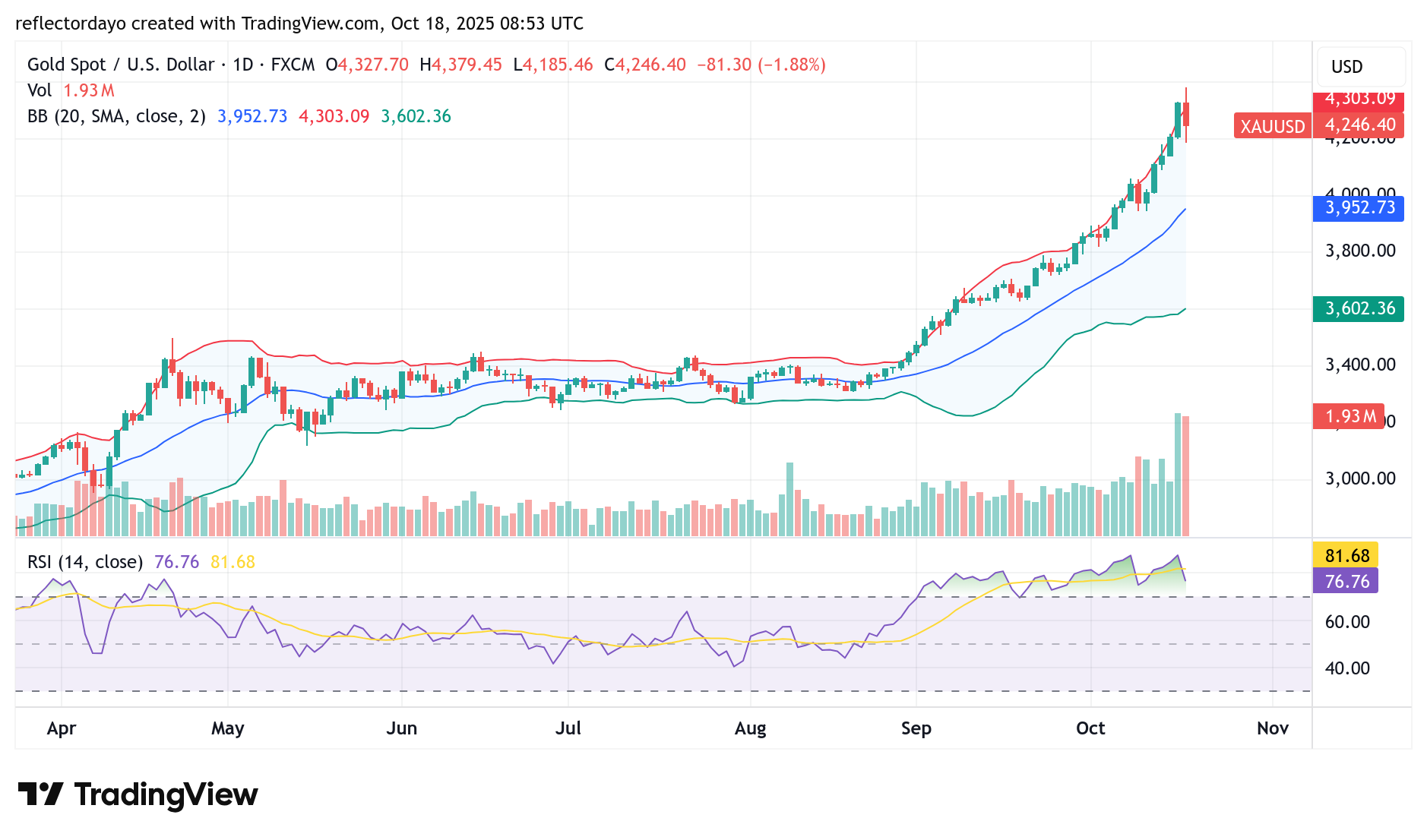
Gold’s broader uptrend remains intact despite the short-term correction. Key support levels are seen at $4,200 and $4,185, while resistance lies at $4,300, $4,350, and the all-time high of $4,389. A sustained close above $4,250 could invite renewed buying momentum, setting the stage for another test of record highs.
Gold Retreats from Record High as Risk Appetite Returns

The price action has moved strongly into the overbought region, reflecting a strong bullish sentiment in the market. The Relative Strength Index (RSI) also confirms this momentum, currently positioned in the overbought zone—a signal that the market may be due for a correction.

However, the formation of the latest candlestick does not suggest that the bears are ready to take control just yet. The bullish momentum remains firm, limiting the chances of an immediate downturn. Still, if the market fails to hold above the $4,200 support level, it could trigger renewed bearish sentiment and open the door for a deeper pullback.

Get access to a lifetime VIP membership. Join us here.

Leave a Reply

Your email address will not be published. Required fields are marked *